Documentary Photography

Great Yorkshire Show 2025
Photographs by Doug Jackson
My documentary work focuses on people, place and social experience. Through sustained, sometimes long-term projects and close engagement with my subjects, I seek to make photographs that are honest, thoughtful and grounded in real lives.
My practice is driven by curiosity and care, using photography as a way to document change, preserve memory and reveal the stories embedded in ordinary moments and overlooked spaces. Whether working independently or on assignment, I approach each project with a strong sense of responsibility to my subjects and to the contexts in which the images are made.
Presented here is a small and personal selection from the over 250 projects made during my 40+ years spent working at the intersection of visual storytelling, social commentary, and lived experience.
Newark Cattle Market, 1983


It was over forty years ago but I remember very distinctly the smell of the air at Newark Livestock Market. It was thick with the scent of sheep, cattle and damp earth, mingling with the sharp tang of fresh straw. Farmers in well-worn jackets gathered in little huddles, their voices a blend of deep-voiced bargains and knowing laughter as friendly banter masked a deep desire to strike a deal. A firm handshake sealed most deals, the kind of agreement that needed no paperwork - just trust, grit, and generations of trade.
The market dates back to 1871 but in March 2020, due to substantial and longstanding rent arrears, Newark and Sherwood District Council terminated the market's lease. The following year, the site was demolished.
This series of photographs was made in 1983 - while a sixth form student at a local school - and by which time I had already formed a burning passion for documentary photography.
Thurcroft Cottage Garden Association, 1984


Thurcroft is a village in South Yorkshire, one kilometre east of the junction of the M1 and M18 motorways. The village name is first mentioned in 1319 but is derived from the anglo-norse ‘Thorscroft’ (Thorir’s farmstead). Formerly a tiny rural hamlet, Thurcroft Colliery was sunk in 1909 and by 1923 the population had grown to around 2,000 transforming the village into a thriving coal-mining community.
Thurcroft’s ‘allotment association’ was formed in 1924 and an ‘annual show’ was the highlight of the gardening year. The colliery closed in 1991 as part of the wider reduction of the British coal industry but the ‘allotment association’ continued to thrive.
Hallaton Bottle Kicking, 2004


Hallaton Bottle Kicking is a “no holds barred” battle between Hallaton and Medbourne, two ancient villages that are on opposing sides of a tributary of the River Welland. The ‘kicking’ is a calendar custom that takes place every Easter Monday as it has for centuries.
In the usually quiet countryside between these two villages, history and heritage is not preserved behind glass; it is hurled, wrestled, and fought over in the mud. Each year on Easter Monday, the ancient custom of Hallaton Bottle Kicking erupts once more, a ritual whose origins blur between pagan rite and medieval sport. For centuries, villagers have gathered to honour this peculiar heritage, one that binds community through spectacle and risk. It is not merely a game; it is an inheritance. Yet woven into its pageantry is a stark reality: this is an event where injury is expected, not exceptional ... and any photographer venturing into the thick of the battle, does so entirely at their own risk!
A Session at De Barra's, 2016
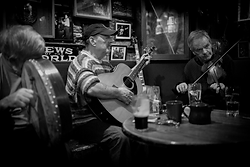


Irish traditional music sessions are vibrant gatherings deeply rooted in the cultural fabric of Ireland. Dating back centuries, these sessions have evolved from informal gatherings in kitchens and pubs to organised events that celebrate the rich musical heritage of the Emerald Isle.
De Barra’s Folk Club at 55 Pearse Street in the pretty West Cork town of Clonakilty is a famous example. A hundred years ago this was a grocery bar with a bakery and storehouse to the rear. Today, it has become one of the most celebrated ‘Trad’ music venues in Ireland. The intimate interior is steeped in music history. On the walls behind the musicians is a treasure trove of music memorabilia - including a Jimi Hendrix Experience platinum disk - providing the perfect backdrop to a session … all within reaching distance of the bar.
Great Yorkshire Show, 2018


The Yorkshire Agricultural Society was established in 1837 by a group of "noblemen and gentry connected with agriculture in the county of Yorkshire" under the Presidency of John Charles Spencer, 3rd Earl Spencer. The following year, 1838, the Society hosted its first annual meeting and exhibition.
Throughout the entire history of the Show, no photographer had ever been granted permission for a triple-A - 'Access All Areas' - pass to photograph behind the scenes and to photograph the Show itself. In 2018, for the 160th Show, I was extremely fortunate to be granted a AAA pass and have returned to the Show almost every year since.
Scooter Culture, 2019


Scooters have a rich and distinct history in England, tied closely to post-World War II industrial recovery, youth subcultures, and evolving urban mobility. Their rise to prominence can be traced through several key phases, reflecting broader social and cultural shifts in the country.
Their cultural legacy is deeply embedded in music, film, and fashion. Films like Quadrophenia helped immortalize the association between scooters and youth rebellion. The image of a sharp-dressed Mod on a Vespa remains iconic and, even in modern fashion, hints to the Mod style continue.
This series of photographs was made at the Scoot to the Waterfront scooter rally organised by Lincoln Knights Scooter Club in July 2019. I visited the rally with members of Harrogate Photographic Society.
Kill the Bill, 2021


On 3 April 2021, thousands of protestors gathered in central London to join the national 'Kill the Bill' day of action. The protests opposed the government’s Police, Crime, Sentencing and Courts Bill, which critics argued threatened the right to demonstrate. The London march, starting at Speakers’ Corner and ending in Parliament Square, became one of the most visible moments in a nationwide movement that drew in activists from across the political spectrum.
My coverage of the ‘Kill the Bill’ day of action was syndicated through various media agencies for national and international distribution. Several of my photographs from the event received awards, including a FIAP Medal for Photojournalism and recognition in the BIPP Regional and National Awards (winning for Editorial Photography and Photojournalism). Photographs from the series were exhibited at events including Photo Suisse International, Images Sans Frontiers and the New York Photo Fair.
The image of the march being blocked by photographers outside Buckingham Palace was chosen by Martin Parr for inclusion in the collection of the Martin Parr Foundation.
Pole Dancers, 2022


Pole dancing is a vibrant and evolving form of artistic expression and physical fitness. With its roots in traditional strip clubs, pole dancing has now transcended its stereotypes to become a respected art form and fitness activity. Performers are often members of organised clubs, run by qualified and experienced teachers, where performers can explore the sensual yet empowering movements of the genre.
This series of photographs, from 2022, documents the set-up and the performances at a pole dance event given by members of the Samantha Walsh Pole Fitness Studio at a private event in Padiham, Lancashire.
Photographs of the behind-the-scenes preparations are made in black-and-white, while the performances are made in colour.
I am grateful for the very kind permission and cooperation provided by Samantha and her team of pole dance performers that allowed me to make this series.
Church on the Street, 2025


This series of photographs, from 2025, is drawn from a larger series about ‘Church on the Street’ (known as COTS) - a remarkable faith-in-action charity and church based in Burnley and working across East Lancashire, including a significant presence in Blackburn.
Homelessness support is one of COTS’s most visible and vital missions. Their Burnley hub provides hot meals, clothing, showers, company, and a warm space for anyone who needs it. Volunteers - many with lived experience of homelessness - offer encouragement and understanding. Beyond meeting immediate needs, COTS helps people find accommodation, navigate services, and build a path toward stability.
Bodybuilders, 2026


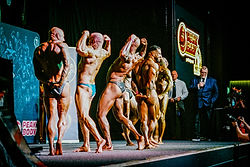

National Amateur Body-Builders' Association (NABBA) has long played a central role in the development of bodybuilding in Britain, promoting a sport built on discipline, physical conditioning, and personal transformation. Founded in 1950, NABBA became internationally recognised through competitions such as Mr Universe, helping establish bodybuilding as both athletic pursuit and public spectacle. What began as a niche form of physical culture has evolved into a global fitness phenomenon, while retaining strong roots in local gyms and regional communities.
In the North East, The Fed in Gateshead has become an important venue for national championships and qualifying events. Under bright stage lighting, competitors present physiques shaped through years of intense training, restrictive dieting, and highly disciplined routines. Muscular symmetry, definition, and presentation are judged in meticulous detail, transforming the body itself into a form of performance.
Durham Miners' Gala, 2026


Founded in 1871 by the Durham Miners' Association, the Durham Miners' Gala, known throughout the North East simply as The Big Meeting, grew from an annual gathering of miners into one of the largest and most enduring celebrations of working-class culture in Europe. At its height, hundreds of thousands of miners and their families travelled from pit villages across the Durham Coalfield, marching behind richly embroidered lodge banners accompanied by brass bands before assembling on Durham's historic Racecourse for speeches championing trade unionism, social justice and political reform.
Although the Gala was interrupted by war and by the industrial disputes of 1921, 1922 and the 1926 General Strike, it survived the closure of Britain's coal mines to become a living expression of collective memory, preserving the traditions, values and solidarity of communities whose livelihoods shaped the social and economic history of the North East.